
Criminal Court Records in Montcalm County
A criminal court record is the official case file a Montcalm County court opens the moment a prosecutor files a charge. The clerk assigns a case number and then logs every event that follows: the complaint and warrant, the arraignment, bond decisions, each hearing, the plea, and the final disposition and sentence. Nothing on the file is a police narrative. It is the court's own account of what was charged and what the judge or jury decided. Because the record is built entry by entry, it is the most complete public account of a criminal case in Montcalm County.
Two trial courts share criminal work in Montcalm County. The 64B District Court is the limited-jurisdiction court that handles adult misdemeanors punishable by up to one year, and it also starts every felony case with the arraignment, bail, the probable-cause conference, and the preliminary examination. If a felony is bound over, it moves to the 8th Judicial Circuit Court, Montcalm County's general-jurisdiction court, where the felony case file and sentencing live. Misdemeanor files stay in District Court. These criminal files are one slice of the broader set of Montcalm County court records the clerks maintain.
Montcalm County's 64B District Court Criminal Division page lays out the rights, plea options, and arraignment steps that shape the earliest entries in a criminal file.
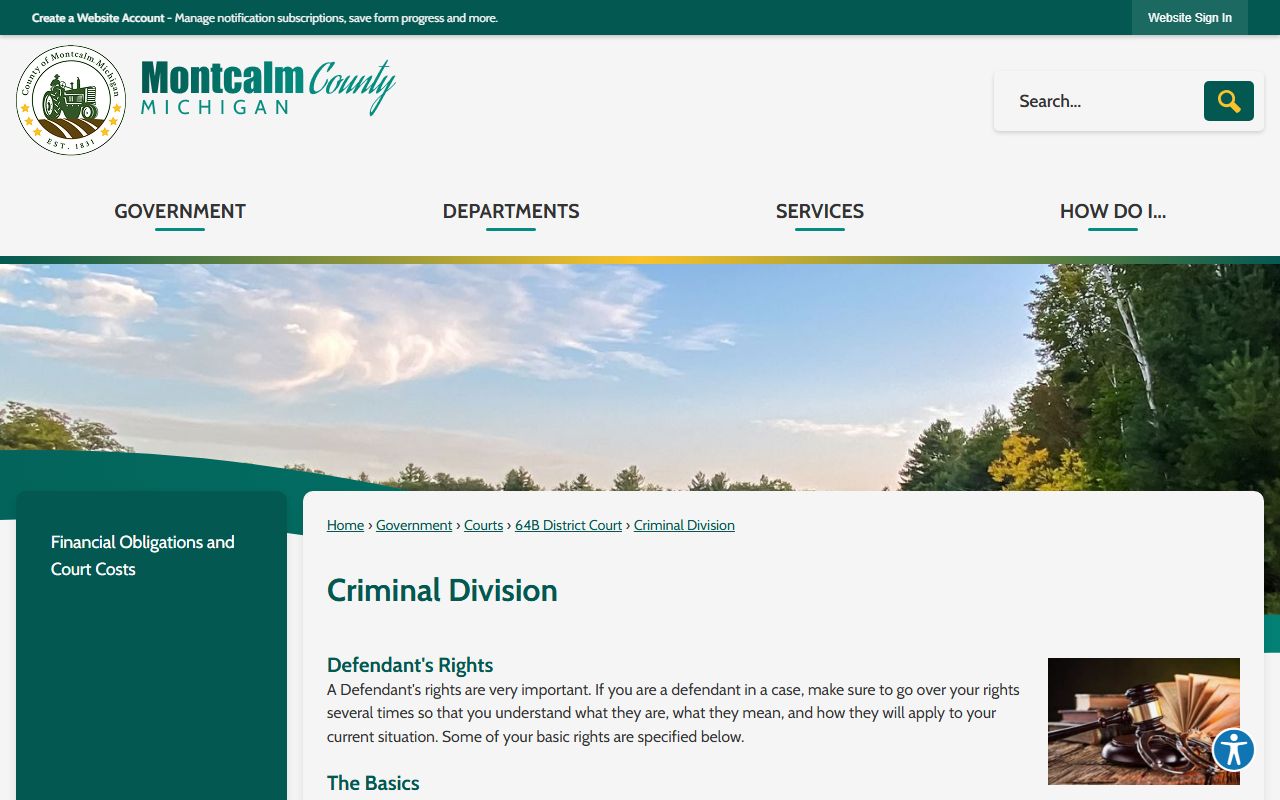
That page is a useful map of the first stage, since nearly every Montcalm County criminal case, misdemeanor or felony, begins with a District Court arraignment before the record grows.
How Montcalm County Criminal Cases Move Through Court
A Montcalm County criminal case leaves a trail of dated entries, and knowing the order of those entries helps you read the file. Charges start the case, the arraignment sets rights and bond, and felonies then pass through a probable-cause conference and a preliminary examination in District Court before any bindover. Misdemeanors skip the bindover and stay put. From there the case reaches a plea or a trial, the court enters a disposition, and sentencing closes it out.
Case flow: Charges Filed › Arraignment › Probable-Cause Conference / Preliminary Exam › Plea or Trial › Disposition › Sentencing
| Stage | What Happens |
|---|---|
| Charges Filed | The prosecutor files a complaint, and often a warrant, and the clerk opens the case and assigns a number. |
| Arraignment | The defendant is told the charges and possible penalties, enters an early plea, and the court sets bond. Defendants may plead guilty, not guilty, stand mute, or no contest. |
| Probable-Cause Conference / Preliminary Exam | Felony-only stages in District Court that test whether enough evidence exists to send the case up to Circuit Court. |
| Plea or Trial | Most cases resolve by plea; others go to a bench or jury trial where guilt must be proven beyond a reasonable doubt. |
| Disposition | The outcome is recorded, whether a plea, a verdict, a dismissal, or an acquittal. |
| Sentencing | On a conviction the court imposes the sentence: jail or prison, probation, fines and costs, restitution, or a specialty-court program. |
How to Search Montcalm County Criminal Court Records
Montcalm County directs the public to MiCOURT Case Search, the statewide Michigan judiciary portal, for criminal case information. It is free, and after you accept the Terms of Service you can search by full name and year of birth or by case number. The portal covers District, Circuit, and Probate cases, and for a criminal file it also shows the fines and costs still owing. Non-public files never appear there.
- Decide which court holds the file. Misdemeanors sit with the 64B District Court, while a felony bound over sits with the 8th Judicial Circuit Court.
- Open MiCOURT Case Search, read the Terms of Service, and click continue.
- Search by the defendant's full name and year of birth, or enter a case number for a direct match.
- Narrow the results by court, case type, and filing date to reach the right defendant.
- Open the case to read the docket, the charges, the plea, the disposition, and any sentence.
- Request a certified copy from the clerk that holds the file when you need an official document.
When a file or a single document is not online, request it from the clerk directly. Certified District Court orders and registers of action can be ordered in person, by phone, or in writing, and Montcalm County says they are usually ready within about two business days. For a felony file, the request goes to the Montcalm County Clerk, who is also Clerk to the 8th Judicial Circuit Court.
Note: A case number returns a single file, while a name search can list several people, so use the number whenever you have it.
What a Montcalm County Criminal Court Record Shows
Once you open a Montcalm County criminal case, the file reads as a set of labeled fields and dated docket entries. Some fields identify the case and the person, while others record what the court decided. The table below covers the fields you will use most when reading a criminal file.
| Field | What It Shows |
|---|---|
| Case Number | The court-assigned identifier used for lookups, payments, and copy requests. |
| CTN | The criminal tracking number that links a case across Michigan systems; it appears on many District Court displays. |
| Defendant | The person charged, matched in a name search by full name and year of birth. |
| Charges | Each offense charged, often with the statute or PACC code, plus the severity level. |
| Plea | The defendant's plea: guilty, not guilty, stand mute, or no contest. |
| Disposition | The final outcome, such as a conviction, a dismissal, or an acquittal. |
| Sentence | The penalty on a conviction: jail or prison, probation, fines and costs, or restitution. |
| Financials | Fines, court costs, restitution, and the balance still owing on the file. |
Reading Dispositions and Sentences in Montcalm County
The disposition line is the heart of a Montcalm County criminal record because it states how the case ended. A guilty plea and a guilty verdict both count as convictions, while a dismissal or an acquittal means no conviction was entered. The plea itself carries meaning too, and Michigan recognizes four postures a defendant may take at arraignment.
- Guilty
- The defendant admits the offense, and the court may move toward sentencing.
- Not guilty
- The defendant denies the charge, sending the case toward pretrial and trial.
- Stand mute
- The defendant says nothing, and the court enters a not-guilty plea on their behalf.
- No contest
- The defendant does not contest the charge; it resolves the case without a direct admission and requires the court's permission.
A sentence can mean jail or prison time, but many Montcalm County cases end in probation supervised through the Circuit Court, along with fines, costs, and restitution. Probation terms and any violations are logged in the file as the case continues. The 8th Circuit Court's probation and parole page describes the supervision and problem-solving programs that shape many local sentences.
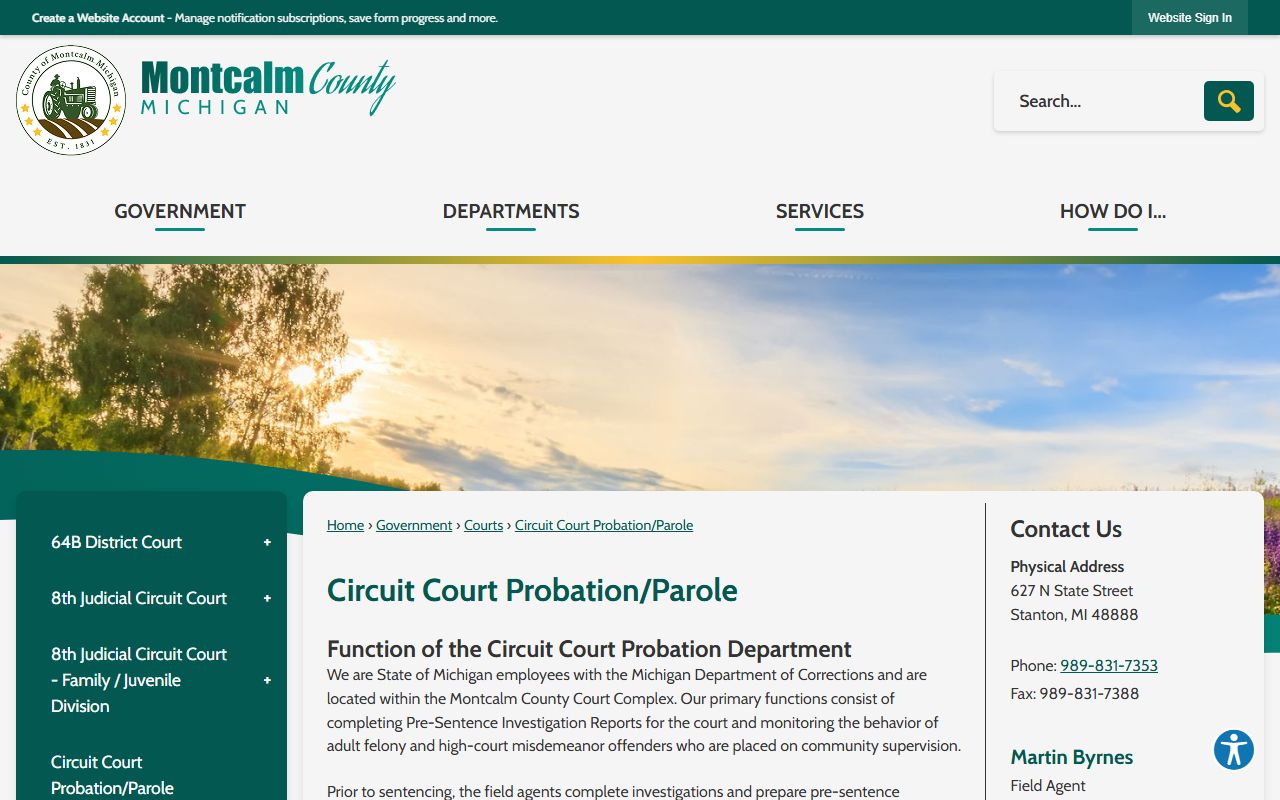
Those programs matter when you read a sentence, because a disposition may route a defendant into treatment and supervision instead of a straight jail term. Montcalm County offers several problem-solving courts as sentencing alternatives, including an Adult Recovery Court, the Mid-Michigan Regional Sobriety Court, a Mid-Michigan Regional Mental Health Court, and the Swift and Sure Sanction Probation Program.
The Mid-Michigan Regional Sobriety Court page explains the drunk- and drugged-driving treatment court that serves Gratiot, Montcalm, and Clinton counties.
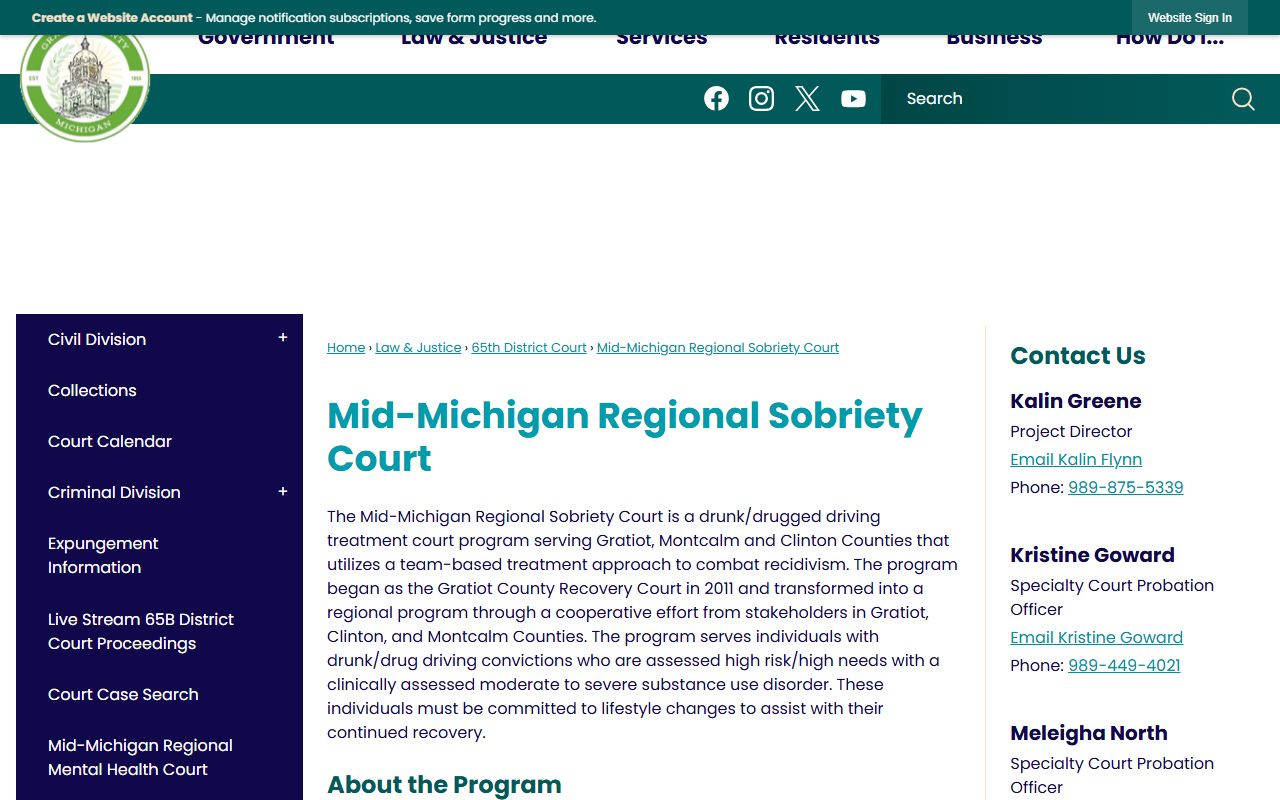
Admission to that court can let an eligible drunk-driving defendant earn a restricted license after installing an ignition interlock device, a detail that helps explain an otherwise unusual sentence in the record.
Note: A specialty-court sentence often lasts longer than a standard probation term, so a Montcalm County case may stay active on the docket for a year or more.
Charges vs. Convictions in Montcalm County
A criminal court record often shows charges that never became convictions. A charge is only an accusation the prosecutor must still prove, and a Montcalm County file can list charges that were later dropped, dismissed, reduced, or that ended in an acquittal. A conviction is the finding of guilt itself, entered by plea or by verdict. For a closer look at how charges are filed and how their status changes, see the county's arrest records and court charges.
| Charge | Conviction | |
|---|---|---|
| What it is | An accusation the state files | A finding of guilt by plea or verdict |
| Burden of proof | Probable cause to charge | Beyond a reasonable doubt |
| Can change to | Amended, reduced, dropped, or dismissed | Sentence, appeal, or later set-aside |
| Public record | Yes | Yes |
Prosecutor and Public Defense in Montcalm County
Two offices shape how a criminal case is charged and defended. The Montcalm County Prosecuting Attorney, Thomas Ginster, is the elected official who decides what charges to file and who represents the county in District and Circuit Court. The prosecutor serves a four-year term, handles appeals in the Michigan Court of Appeals and Supreme Court, and attends contested mental-health commitment hearings, among other duties. Montcalm County's Prosecuting Attorney page lists the office's full set of duties and its divisions.
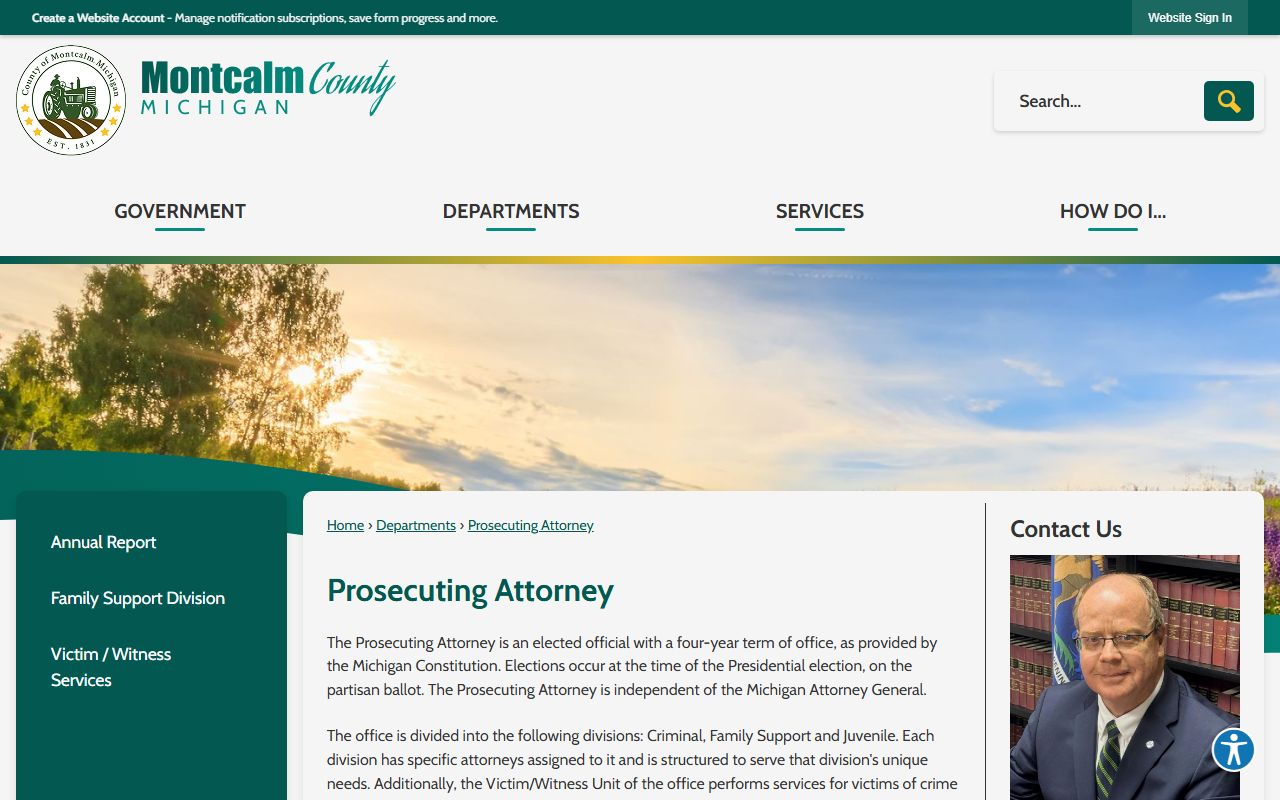
Because charging decisions start with this office, its work is the first thing reflected in the charges on a criminal record. Defendants who cannot afford a lawyer are represented through Montcalm County Public Defense, which provides counsel for all criminal defendants at arraignment. A judge or magistrate decides who qualifies based on indigency and whether the offense could bring jail time, and if the Montcalm County court appoints an attorney at public expense the defendant may later repay some of that cost.
Montcalm County's Public Defense page explains how to request an appointed attorney and lists the roster of appointed counsel.
Whether a defendant had appointed or retained counsel becomes part of the case history the court file records.
Public Access to Montcalm County Criminal Court Records
Michigan treats court proceedings and their records as public by default. Court sittings are generally open, and the files behind them are open for inspection unless a statute, a court rule, or a judicial order restricts a specific record. That is why most Montcalm County criminal case files can be searched online and copied at the clerk's counter.
Key Statutes:
MCL 600.1420 - Court sittings in Michigan are generally open to the public.
Michigan Court Rule 8.119 - Court records are open for inspection unless a statute, rule, or order restricts access.
Note: Even in an open file, the Montcalm County court may redact personal identifiers such as birth dates and Social Security numbers before releasing a copy.
Montcalm County Police Reports and Criminal History
A Montcalm County criminal court record is not the same as a police report. The 64B District Court says plainly that it does not provide police reports, because those belong to the agency that wrote them. To get an incident or investigative report, send a Freedom of Information Act request to the right office, and expect a written request and a fee. Michigan's FOIA policy favors disclosure, while its list of exemptions lets an agency withhold or redact protected material.
Requests for police records generally go to one of these:
- The police agency that wrote the report, through its own FOIA process.
- The Montcalm County Prosecuting Attorney or the city attorney handling the case.
- The Montcalm County Sheriff's Office, whose records all require a FOIA request.
For a statewide criminal history rather than a single case, the District Court points people to the Michigan State Police ICHAT service, not the court. ICHAT returns Michigan conviction history, while a MiCOURT search returns individual case files by court. The two answer different questions, so serious background research often uses both.
Sealed vs. Expunged Criminal Records in Montcalm County
Some Montcalm County criminal records are removed from public view. In Michigan the main tool is a set-aside, the state's word for expungement, which makes an eligible conviction nonpublic. Sealing hides a record from public search but keeps it available to limited parties, while a set-aside treats the conviction as though it should no longer appear in ordinary public results. Both are narrower than most people expect.
| Sealed | Expunged (Set Aside) | |
|---|---|---|
| Visibility | Hidden from public inspection | Made nonpublic under Michigan's set-aside law |
| Law enforcement | Limited access remains | Very limited; kept for specific official uses |
| How it happens | By statute or court order in specific cases | By application on form MC 227, or automatically under Clean Slate |
| Eligibility | Case-specific, set by law | Set by MCL 780.621, with waiting periods by offense |
An application set-aside is filed in the court where the conviction happened, with a separate application for each court. Form MC 227 asks the applicant to list the convictions, attach a certified copy of each, and swear to the application before a clerk or notary, and the hearing cannot happen until the Michigan State Police report is on file. Since April 2023, Michigan's Clean Slate program has also set aside some eligible convictions automatically, with no application at all. The set-aside statute, MCL 780.621, defines who qualifies and how long the wait runs.
The Michigan State Police conviction set-aside page explains what the process changes and how automatic set-asides work.
For a Montcalm County conviction, the application goes to the 64B District Court for a district case or to the Circuit Court Clerk for a circuit case, because a set-aside is filed in the court that entered the conviction.
Restricted Montcalm County Criminal Court Records
Not every criminal-related file is open. Montcalm County's Case Search page warns that non-public files never appear online, and several categories carry access limits set by statute or court rule. When a record is restricted, the path is to contact the court that holds it rather than to assume a public search will return it.
- Juvenile cases: delinquency and child-protective matters in the Family Division carry statutory access limits.
- Adoption records: handled through Juvenile Court and treated as confidential.
- Mental-health proceedings: commitment and treatment matters touch Probate Court and are often restricted.
- Set-aside or Clean Slate convictions: dropped from ordinary public results once the record is made nonpublic.
- Name-change orders: released only to the person whose name was changed, or to the petitioner in a minor's case.
- Sealed personal identifiers: birth dates, addresses, and similar data may be redacted before release.