
Montcalm County Arrest Records and Court Charges
A Montcalm County arrest record is the account of an arrest itself. It shows who was taken into custody, which agency made the arrest, and the booking that follows at the county jail. The arrest is only the start. After an arrest, the Montcalm County Prosecuting Attorney reviews the police report and decides which formal charges to file with the court. Those filed charges become the court charge record, a separate file that follows the case from the first hearing to its final outcome. Arrest records and charge records answer different questions, so it helps to treat them as two connected but distinct records.
The arrest and booking side lives with the sheriff and the jail. Booking details, custody status, and bond instructions sit on the jail side of the system, and the Montcalm County inmate records page covers the jail roster channels and the automated court-status line. The court charge record is different. It captures the charges the prosecutor actually filed, the charge codes, and how each charge changes as the case moves. The full case file, including pleas, disposition, and sentencing, is tracked as the matter proceeds, and the Montcalm County criminal court records page follows that case from charge to judgment. Court charges after arrest are public in Montcalm County unless a statute or court order restricts the file.
How to Find Montcalm County Arrest Records and Charges
Charges filed after an arrest show up in the court case index, so the fastest way to trace them is MiCOURT Case Search, the free statewide portal the Michigan judiciary runs. Montcalm County directs the public to the same tool and publishes its own short instructions. A search returns the case number, the parties, the charges, and the docket events, though non-public files never appear. The arrest and booking report itself is a sheriff record rather than a court record, and it is released through a written Freedom of Information Act request rather than the case portal.
- Open MiCOURT Case Search and accept the Terms of Service.
- Search by the defendant's full name and year of birth, or by case number for a direct hit.
- Open the matching case and read the list of charges filed after the arrest.
- Check each charge's statute code, severity level, and current status.
For a person who was just arrested, the Montcalm County Jail runs an automated court date and status line at 989-831-7592. The system updates after court actions, and callers who reach it before the docket posts are told to try again after 3 p.m. on weekdays. Statewide criminal history and charge lookups add another layer and are covered further down.
The Michigan Attorney General FOIA overview explains the written-request rule that governs arrest and police reports across the state.
Because the arrest report is held by the arresting agency, a FOIA request to that agency, not a court search, is what produces the booking narrative behind a Montcalm County arrest record.
How Charges Get Filed After a Montcalm County Arrest
After an arrest, the charge record begins when a prosecutor files a charging document with the court. In Montcalm County that decision rests with the Prosecuting Attorney, Thomas Ginster, an elected official who represents the county in criminal matters before both the 64B District Court and the 8th Judicial Circuit Court. Michigan uses the title Prosecuting Attorney rather than District Attorney, but the role is the same. The prosecutor reviews the arrest and the evidence, then chooses the charges, how many to bring, and at what level. Michigan criminal cases start through one of three charging documents.
| Complaint | Information | Indictment | |
|---|---|---|---|
| Filed By | Officer / Prosecutor | Prosecutor | Grand Jury |
| Common For | Misdemeanors | Many felonies | Serious felonies |
| Starts | The case | The case | The case |
A complaint is the most common starting point in Montcalm County, since misdemeanors and most felonies begin with a complaint and warrant in the 64B District Court. An information is the felony charging document used after a case is bound over to Circuit Court. Grand jury indictments are rare in Michigan state practice. Whatever the document, the charges it lists are what a Montcalm County arrest records search will show once the case is filed.
Montcalm County Charge Status and What It Means
Charges rarely stay frozen. As a case moves through the Montcalm County courts, a charge can be amended, reduced, added, dropped, or dismissed, and the case index tracks each change. A charge status is not a verdict. It only tells you where a particular count stands right now. Reading the status next to each charge is the difference between assuming an outcome and knowing one.
| Status | What It Means |
|---|---|
| Pending | The charge has been filed and the case is still open, with no plea or verdict entered yet. |
| Amended / Reduced | The prosecutor changed the charge, often to a lower level or a different offense. |
| Dismissed | The court dropped the charge, and it no longer moves forward in the case. |
| Nolle Prosequi | The prosecutor formally declined to pursue the charge, ending it without a conviction. |
Note: A dropped or dismissed charge can still appear in a Montcalm County arrest record unless the file is later set aside under Michigan law.
Charges vs Convictions in Montcalm County
Being charged is not the same as being convicted. A charge is the accusation the prosecutor files after an arrest, and it rests on probable cause. A conviction comes only after a plea or a verdict that meets a much higher standard of proof. Both stages are public record in Montcalm County, so a search can show a charge that never led to a conviction. The table below lines up the two.
| Charge | Conviction | |
|---|---|---|
| Stage | Accusation | Verdict or plea |
| Burden of Proof | Probable cause | Beyond reasonable doubt |
| Public Record | Yes | Yes |
This distinction matters when reading any Montcalm County arrest record. A long list of filed charges can still end in a dismissal, a reduced plea, or an acquittal, and only the final disposition tells the full story.
Montcalm County Charge Codes and Severity Levels
Every Montcalm County charge is tied to a statute, and Michigan labels each offense with a code. Docket displays in Montcalm County may show a PACC code, the Prosecuting Attorneys Coordinating Council code that maps a charge to its statute, alongside the case number and the criminal tracking number, or CTN. Severity drives where the case is heard. A misdemeanor is a lower-level offense handled in the 64B District Court when the possible punishment does not exceed one year. A felony is more serious. It begins in District Court for arraignment and preliminary proceedings, then moves up if the defendant is bound over. A civil infraction, such as most traffic tickets, is not criminal at all. One arrest can produce several separate charges at different levels, and each carries its own code and its own status.
Arraignment and Bond in Montcalm County District Court
The first court event after a Montcalm County arrest is arraignment, held in the 64B District Court at 617 N State Street in Stanton. At arraignment the judge or magistrate reads the charges, explains the possible penalties, and sets bond or bail. A defendant may plead guilty, not guilty, stand mute, or no contest, and the county Public Defender's Office can provide representation for defendants at arraignment. Bond is the money or set of conditions that allow release while requiring a return to court.
Felony charges do not stay in District Court. After arraignment, a felony moves through a probable-cause conference and a preliminary examination in the 64B District Court. If the judge finds enough evidence, the case is bound over to the 8th Judicial Circuit Court, and the record path shifts to the County Clerk, who also serves as Circuit Court Clerk. Misdemeanor charges stay in the District Court from start to finish. For a defendant already in custody, the jail's automated line at 989-831-7592 is the quickest way to confirm the next court date and the bond amount.
Statewide Charge and Criminal History Lookups
Local charges roll up into statewide systems, and several tools reach beyond Montcalm County. The Michigan State Police runs ICHAT, the Internet Criminal History Access Tool, which returns Michigan felony and serious misdemeanor conviction history for a fee. Convictions, not mere arrests, are what a criminal history report is built to show, so ICHAT is the state's official charge-to-conviction record.
For people under state corrections supervision, the Michigan Department of Corrections publishes the Offender Tracking Information System, or OTIS. It covers current and recent prisoners, parolees, probationers, and absconders, and it searches by name or offender number. OTIS is a state system and not a Montcalm County jail roster, so a person held only in the county jail may not appear there.
The Michigan Sex Offender Registry search form lets anyone check registered offenders across the state, including those living in Montcalm County.
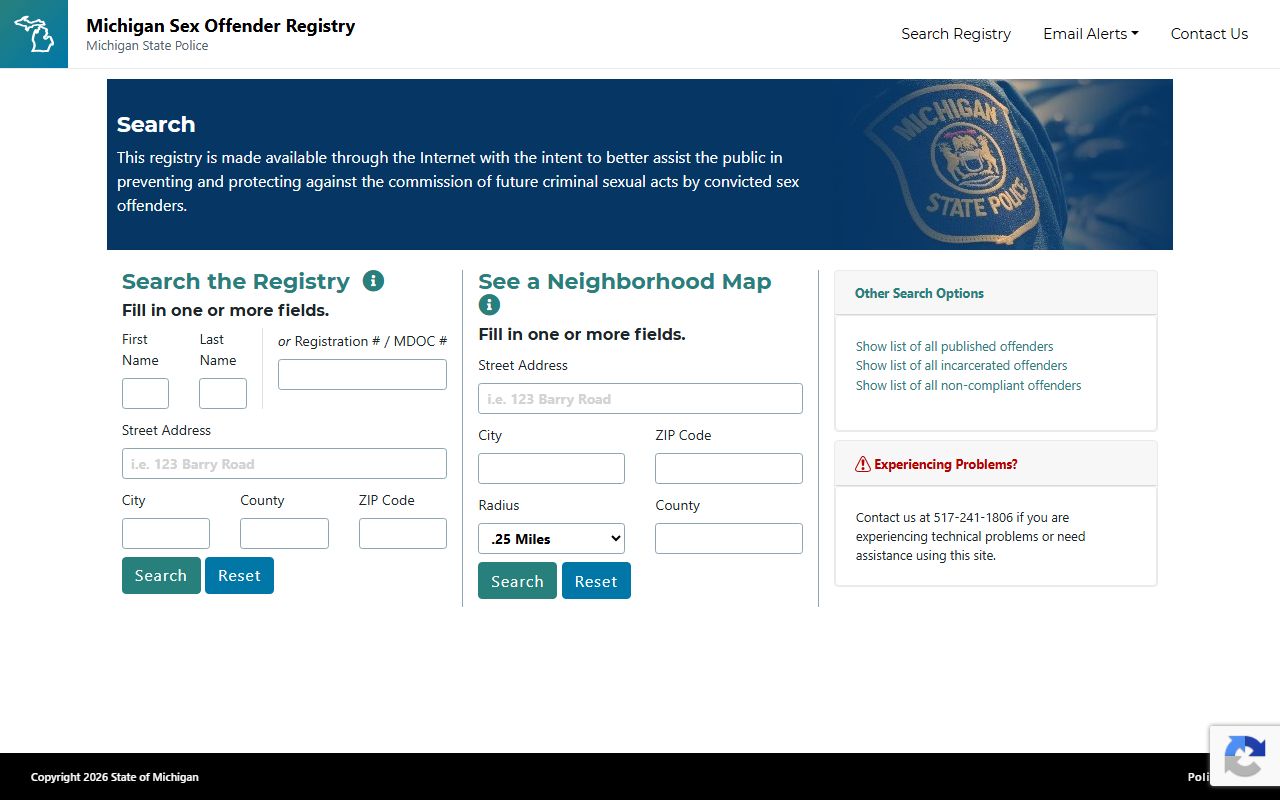
A registry hit reflects a conviction that carries a reporting duty, which is very different from a simple arrest record. Michigan also explains how and where offenders must report.
The Michigan State Police sex offender registry options page outlines the search choices and the reporting rules the state enforces.
In Montcalm County, registration verification and address changes are handled at the jail on set weekday hours, with some residents reporting instead to their local police agency.
Police Reports and FOIA in Montcalm County
The court file shows the charges, but it does not include the police report behind them. In Montcalm County the courts do not hand out police reports. Those reports, arrest narratives, and other sheriff records are released only through a written Freedom of Information Act request to the agency that holds them. The county asks requesters to submit the request in writing and to wait for a cost estimate before paying anything.
The Montcalm County Sheriff's Office records page states that all sheriff records require a FOIA request, and it routes accident reports through a separate service.
A full picture of a Montcalm County arrest record often means pairing the court charge file with a FOIA request for the underlying report. Written FOIA requests go to the county by mail, hand delivery, fax, or email to foia@montcalmcountymi.gov. Michigan's Freedom of Information Act, MCL 15.231, sets the policy favoring access, while MCL 15.243 lists the exemptions that let an agency withhold or redact protected material.
Set-Aside Limits for Montcalm County Charges
Michigan does not use the word sealed the way some states do. It uses set aside, the term for making an eligible conviction nonpublic. Charges that end without a conviction, such as a dismissal or a nolle prosequi, are not convictions, yet the record of the case can still surface until it is addressed. A set-aside applies to convictions, and it removes them from public view once granted.
Michigan's set-aside law, MCL 780.621, defines which convictions can be set aside and the waiting periods that apply.
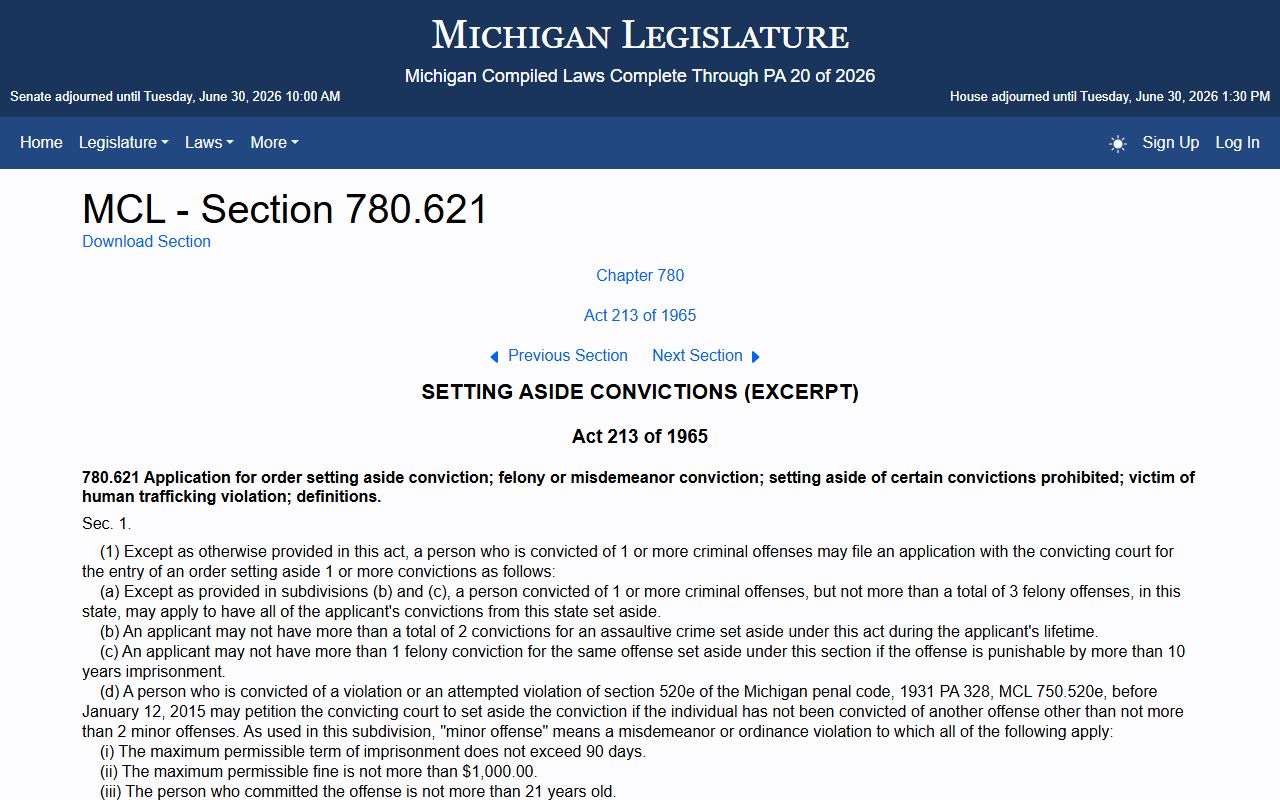
The statute sets tiered waiting periods, and Michigan's Clean Slate program now sets aside many eligible convictions automatically. An application set-aside is still available for convictions that automation does not reach. The applicant files SCAO form MC 227 in the court where the conviction happened, so a 64B District Court conviction is filed there and a Circuit Court conviction goes to the County Clerk. A separate application is needed for each court. The form requires listing the convictions, attaching a certified copy of each, swearing to the application before a clerk or notary, and serving the prosecutor, the Attorney General, and the Michigan State Police. Waiting periods run to five years for certain serious offenses or a single felony, three years for eligible misdemeanors, and five years for a first-offense operating while intoxicated. A hearing cannot be held until the court receives the required Michigan State Police report.
Background Check Considerations for Montcalm County
People search Montcalm County arrest records for many reasons, but not every lookup is a legal background check. A casual search of Montcalm County charges on a free portal is fine for personal knowledge. A background check used for hiring, housing, credit, or insurance is regulated by the federal Fair Credit Reporting Act and must run through a compliant screening service that follows notice and accuracy rules.
Important: This site is not a consumer reporting agency under the Fair Credit Reporting Act, and its information cannot be used for employment, tenant, credit, or insurance screening.
Restricted Charge Records in Montcalm County
Not every charge is open to the public. Juvenile charges handled through the county's Juvenile Court carry statutory access limits, and the safest path is to contact the court rather than assume a public search will work. Charges tied to an open investigation may be withheld until the matter is charged or closed. A conviction that has been set aside becomes nonpublic and drops off the case index. A name-change order tied to a case can be released only to the person whose name was changed, or to the petitioner in a case involving a minor. When a record does not appear in a Montcalm County arrest records search, one of these limits is often the reason.